
Maths by Vikash Sharma
Expert Educator | Class 10
📘 Statistics Class 10 Notes (Chapter 14)
🔷 Introduction
Statistics helps us collect, organize, and study data. In simple words, statistics turns numbers into useful information. Therefore, students can understand large sets of data more easily.
Moreover, people use statistics in schools, business, sports, science, and research. As a result, this chapter has many real-life uses.
🔷 What is Data?
Data means a collection of facts, numbers, or observations.
For example, marks of students, daily temperatures, or cricket scores all form data. Thus, data helps us compare and analyze information.
🔷 Types of Data
Understanding data types makes this chapter easier. Therefore, learn these types carefully.
✔ Raw Data
Raw data is the original data collected directly.
For example:
12, 15, 10, 18, 14, 16
✔ Grouped Data
Grouped data organizes values into classes.
For example:
| Class Interval | Frequency |
|---|---|
| 0–10 | 5 |
| 10–20 | 8 |
| 20–30 | 6 |
Thus, grouped data looks clean and easy to study.
🔷 Frequency
Frequency shows how many times a value appears.
For example, if 10 appears three times, then frequency = 3.
🔷 Class Interval
A class interval shows a range of values.
For example:
10–20, 20–30, 30–40
🔷 Class Mark
Class mark is the middle value of a class interval.
Formula:Class Mark=2Upper Limit+Lower Limit
Therefore, class mark helps in calculations.
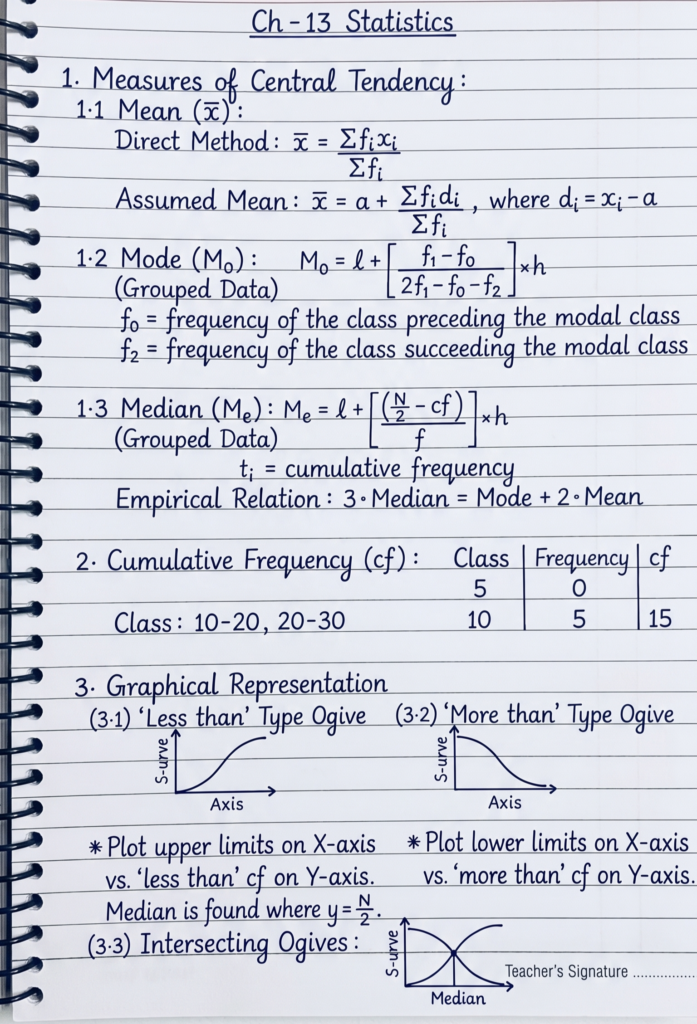
🔷 Mean
Mean gives the average value of data.
Formula for Ungrouped Data
Mean=Number of observationsSum of observations
Formula for Grouped Data
xˉ=∑fi∑fixi
Where:
- fi = frequency
- xi = class mark
Thus, mean shows the central value.
🔷 Assumed Mean Method
Sometimes numbers become large. Therefore, we use the assumed mean method.
Formula:xˉ=a+∑fi∑fidi
Where:
- a = assumed mean
- di=xi−a
🔷 Step Deviation Method
This method makes calculations easier. Moreover, it saves time in exams.
Formula:xˉ=a+∑fi∑fiui×h
Where:
- ui=hxi−a
🔷 Median
Median is the middle value of data.
Therefore, median divides data into two equal parts.
Formula of Median
Median=l+(f2n−cf)×h
Where:
- l = lower boundary
- n = total frequency
- cf = cumulative frequency
- f = frequency
- h = class size
🔷 Mode
Mode is the value with highest frequency.
In other words, mode shows the most common observation.
Formula of Mode
Mode=l+(2f1−f0−f2f1−f0)×h
Where:
- f1 = modal class frequency
- f0 = previous frequency
- f2 = next frequency
🔷 Empirical Relation
This relation connects mean, median, and mode.
Formula:Mode=3Median−2Mean
Therefore, this formula helps verify answers.
🔷 Solved Example
Example
Find the mean of:
5, 7, 9, 11, 13
Solution
Sum:5+7+9+11+13=45
Number of observations:5
Now use:Mean=545 Mean=9
Answer:
Mean = 9
🔷 Important Tips
Students can score full marks by following these tips.
- Make tables carefully.
- Check frequencies twice.
- Write formulas first.
- Solve step by step.
- Always write units if needed.
Thus, neat work improves accuracy.
🔷 Real-Life Uses
People use statistics in many fields. For example, statistics helps in:
- School results
- Cricket analysis
- Business reports
- Medical research
- Population studies
- Weather reports
Therefore, statistics plays an important role in daily life.
Statistics helps us collect, organize, and study data.
Mean is the average value of data.
Median is the middle value of data.
Mode is the most frequent value
Frequency shows how many times a value appears.