Maths by Vikash Sharma
Expert Educator | Class 10
📘 Real Numbers Class 10 Notes (Chapter 1) – Complete Explanation
🔷 Introduction to Real Numbers
Real Numbers are a fundamental concept in mathematics that include different types of numbers such as natural numbers, whole numbers, integers, rational numbers, and irrational numbers. These concepts are essential for building a strong foundation in Class 10 Maths.
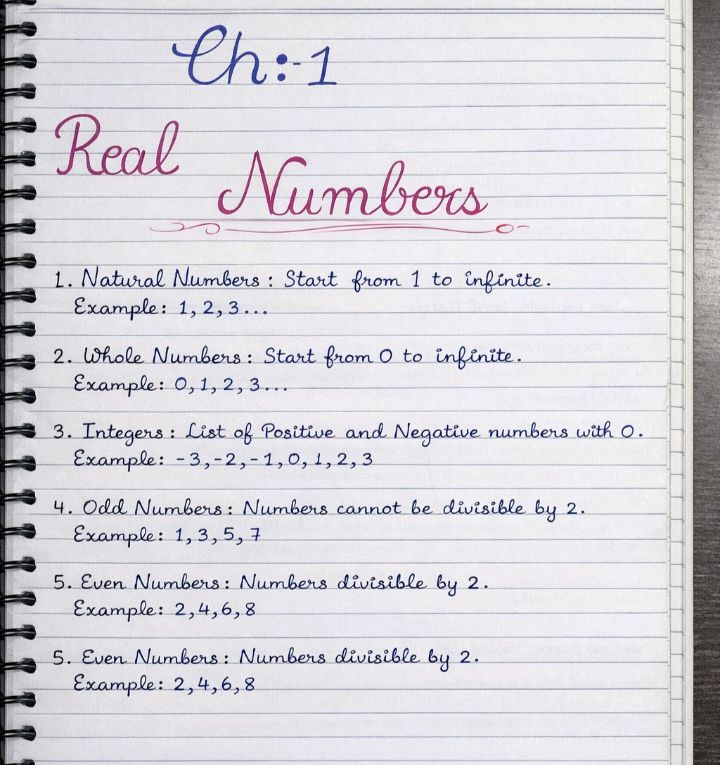
🔹 1. Natural Numbers
Natural numbers are the counting numbers that start from 1 and go to infinity.
Examples:
1, 2, 3, 4, 5, …
👉 These are used for counting objects.
🔹 2. Whole Numbers
Whole numbers include all natural numbers along with zero.
Examples:
0, 1, 2, 3, 4, …
👉 Whole numbers start from 0 and extend to infinity.
🔹 3. Integers
Integers include all positive numbers, negative numbers, and zero.
Examples:
-3, -2, -1, 0, 1, 2, 3
👉 Used in situations like temperature, profit/loss, etc.
🔹 4. Odd Numbers
Odd numbers are numbers that are not divisible by 2.
Examples:
1, 3, 5, 7, …
🔹 5. Even Numbers
Even numbers are numbers that are divisible by 2.
Examples:
2, 4, 6, 8, …
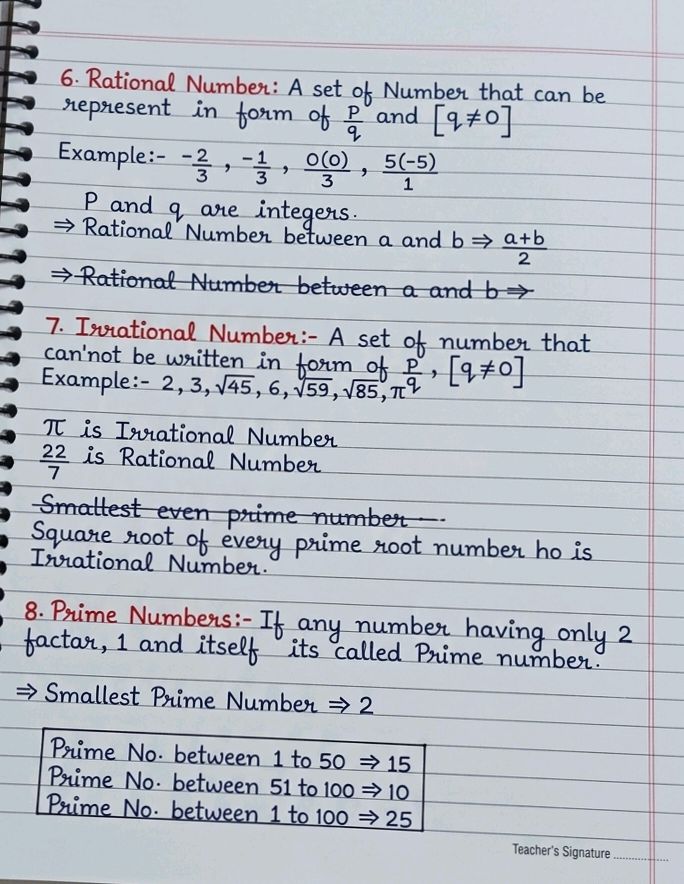
🔹 6. Rational Numbers
Rational numbers are numbers that can be written in the form:qp,where p,q are integers and q=0
Examples:
-2, -1, 0, 1/2, 5, -5
👉 Key Property:
There are infinitely many rational numbers between any two numbers.
Formula to find a rational number between a and b:2a+b
🔹 7. Irrational Numbers
Irrational numbers are numbers that cannot be written in the form of p/q.
Examples:
√2, √3, √5, π
👉 Their decimal expansion is non-terminating and non-repeating.
🔹 Important Concept
✔ Square root of any prime number is always an irrational number.
🔹 8. Prime Numbers
Prime numbers are numbers that have only two factors: 1 and itself.
Examples:
2, 3, 5, 7, 11, …
👉 Smallest prime number = 2
🔹 Prime Number Facts
- Prime numbers between 1 to 50 → 15
- Prime numbers between 51 to 100 → 10
- Total prime numbers between 1 to 100 → 25
Real numbers include all rational and irrational numbers.
A number that can be written in the form p/q where q ≠ 0.
Numbers that cannot be expressed as p/q and have non-terminating decimals.
The smallest prime number is 2.