
Maths by Vikash Sharma
Expert Educator | Class 10
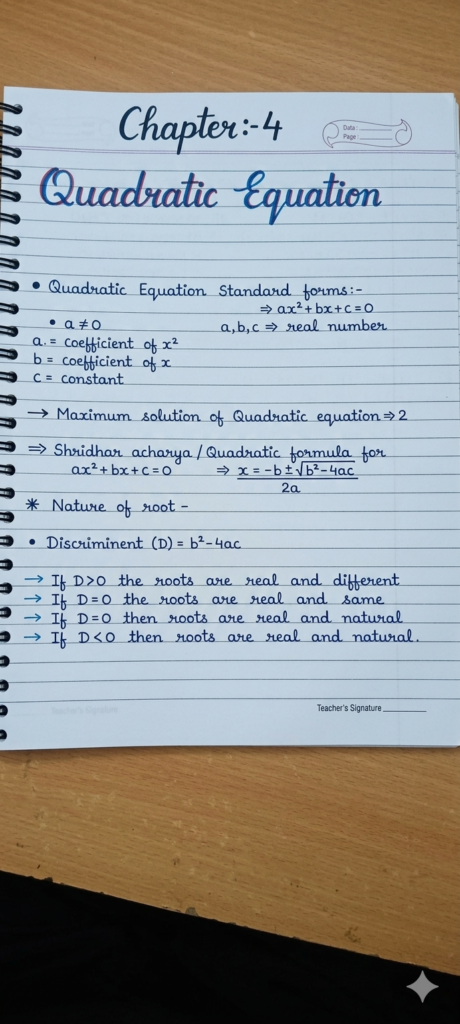
📘 Quadratic Equations Class 10 Notes (Chapter 4)
🔷 Introduction
Quadratic equations are an important topic in algebra. In simple words, a quadratic equation is an equation in which the highest power of the variable is 2.
For example:x2+5x+6=0
Therefore, every equation with degree 2 is called a quadratic equation.
🔹 Standard Form of Quadratic Equation
The standard form of a quadratic equation is:ax2+bx+c=0
Here:
- a, b, c are real numbers
- a ≠ 0
Moreover, if a becomes zero, the equation will no longer be quadratic.
🔹 Examples of Quadratic Equations
Some common examples are:
- x2+3x+2=0
- 2×2+7x+5=0
- 5×2−4x+1=0
🔷 Methods to Solve Quadratic Equations
There are three main methods.
🔹 1. Factorization Method
In this method, we split the middle term and find factors.
👉 Example:x2+5x+6=0
Factorizing:x2+2x+3x+6=0 x(x+2)+3(x+2)=0 (x+2)(x+3)=0
So,x=−2,x=−3
Hence, these are the roots.
🔹 2. Completing the Square Method
In this method, we make a perfect square.
👉 Example:x2+6x+5=0 x2+6x=−5
Add 9 on both sides:x2+6x+9=4 (x+3)2=4 x+3=±2
So:x=−1,x=−5
🔹 3. Quadratic Formula Method
The formula is:x=2a−b±b2−4ac
Therefore, this method works for every quadratic equation.
🔷 Discriminant
The value inside the square root is called the discriminant.D=b2−4ac
The discriminant tells us about the nature of roots.
🔹 Nature of Roots
✔ If D > 0
Two distinct real roots.
✔ If D = 0
Two equal real roots.
✔ If D < 0
No real roots.
Thus, the discriminant helps us understand the solution quickly.
🔷 Roots of Quadratic Equation
If α and β are roots of:ax2+bx+c=0
Then:
Sum of roots:
α+β=−ab
Product of roots:
αβ=ac