Maths by Vikash Sharma
Expert Educator | Class 10
NOTES

Here’s Class 10 Maths Chapter 15 Notes – Probability in Yoast-friendly, SEO-optimized format 👇
📘 Probability Class 10 Notes (Chapter 14)
🔷 Introduction
Probability helps us predict the chance of an event. In simple words, probability tells us how likely something is to happen. Therefore, this chapter helps students understand uncertainty in a mathematical way.
Moreover, people use probability in games, weather reports, business, sports, and science. As a result, this chapter has many real-life applications.
🔷 What is Probability?
Probability measures the chance of an event happening.
For example, when you toss a coin, you may get head or tail. Thus, probability helps us measure that chance.
🔷 Important Terms
Understanding these terms makes this chapter easier. Therefore, learn them carefully.
✔ Experiment
An action that produces results is called an experiment.
For example:
- Tossing a coin
- Rolling a dice
- Picking a card
✔ Outcome
A possible result of an experiment is called an outcome.
For example:
When you toss a coin:
Head or Tail
These are outcomes.
✔ Event
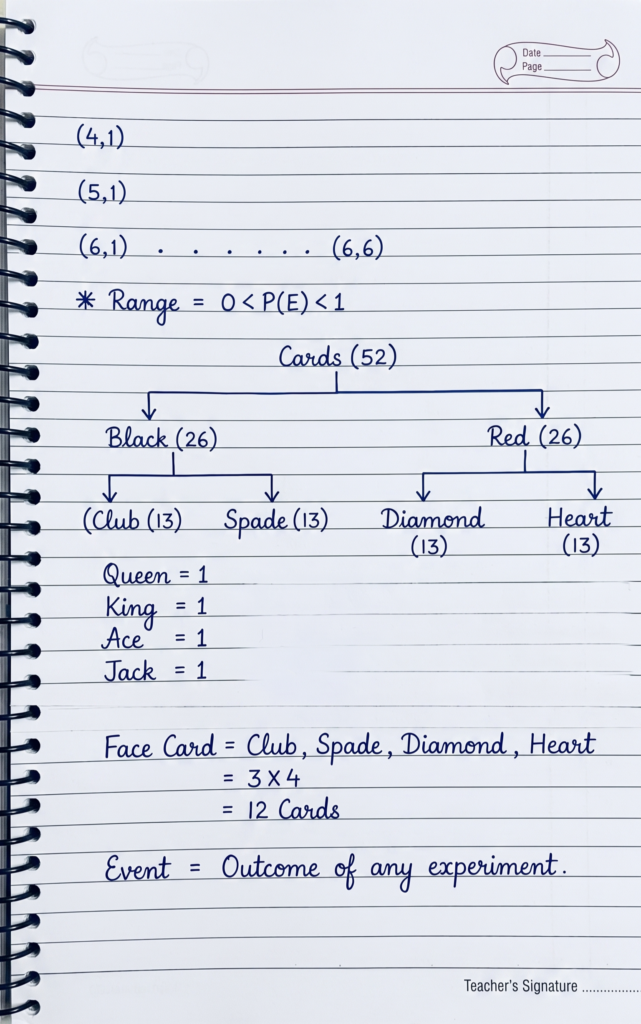
A group of one or more outcomes is called an event.
For example:
Getting an even number on a dice.
✔ Sample Space
The set of all possible outcomes is called sample space.
Represented by:S
Example of Sample Space
Tossing one coin:
S={H,T}
Rolling one dice:
S={1,2,3,4,5,6}
Thus, sample space contains all possible outcomes.
🔷 Formula of Probability
The probability of an event is:P(E)=Total number of possible outcomesNumber of favourable outcomes
Therefore, probability always compares favorable outcomes with total outcomes.
🔷 Range of Probability
Probability always lies between 0 and 1.0≤P(E)≤1
Special Cases
Impossible Event
If an event cannot happen:P(E)=0
For example:
Getting 7 on one dice.
Certain Event
If an event always happens:P(E)=1
For example:
Getting a number less than 7 on a dice.
🔷 Probability of a Coin Toss
A coin has two possible outcomes:{H,T}
Probability of Head
P(H)=21
Probability of Tail
P(T)=21
Thus, both outcomes have equal chance.
🔷 Probability of Rolling a Dice
Sample space:S={1,2,3,4,5,6}
Probability of Getting 4
Favorable outcomes = 1
Total outcomes = 6P(4)=61
Probability of Getting an Even Number
Even numbers:{2,4,6}
Favorable outcomes = 3P(Even)=63=21
Therefore, even numbers have a 50% chance.
🔷 Probability of Drawing a Card
A standard deck has 52 cards.
Probability of Drawing an Ace
Number of aces = 4P(Ace)=524 =131
Probability of Drawing a King
Number of kings = 4P(King)=131
🔷 Complementary Events
If E is an event, then:P(E)+P(Eˉ)=1
Therefore, if one event happens, its complement does not happen.
🔷 Solved Example
Example
Find the probability of getting an odd number on a dice.
Solution
Sample space:{1,2,3,4,5,6}
Odd numbers:{1,3,5}
Favorable outcomes = 3
Total outcomes = 6
Now use:P(E)=63 =21
Answer:
Probability = 1/2
🔷 Important Tips
Students can score full marks by following these tips.
- Write sample space first.
- Count outcomes carefully.
- Simplify fractions.
- Check total outcomes twice.
- Use formulas clearly.
Thus, neat steps improve accuracy.
🔷 Real-Life Uses
People use probability in many areas. For example, probability helps in:
- Weather forecasting
- Sports analysis
- Business decisions
- Insurance
- Medical research
- Games
Therefore, probability has many practical uses.
Probability measures the chance of an event.
Sample space contains all possible outcomes.
P(E)=Favourable outcomes/Total outcomes
0≤P(E)≤1
An event that cannot happen.
An event that always happens.
P(E)+P(Eˉ)=1