
Maths by Vikash Sharma
Expert Educator | Class 9
📘 Class 9 Maths Chapter 2: Polynomials (Complete Notes)
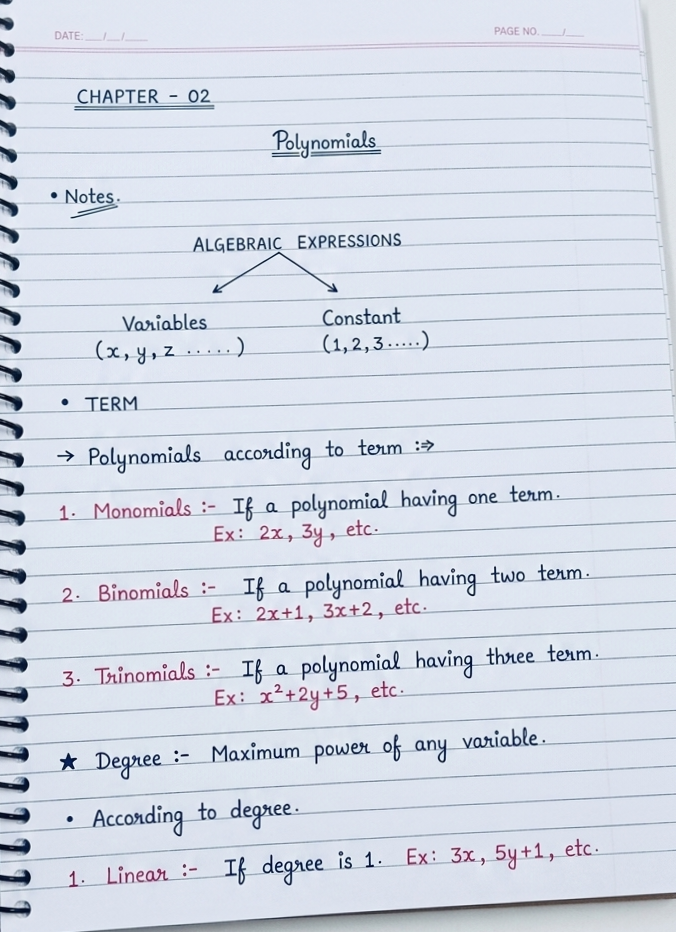
🔹 Introduction
A polynomial is an algebraic expression consisting of variables, constants, and exponents connected by +, −, ×.
👉 Example:
x² + 3x + 5
🔹 Definition of Polynomial
General form:
aₙxⁿ + aₙ₋₁xⁿ⁻¹ + … + a₁x + a₀
Where:
x = variable
a₀, a₁, a₂… = constants
🔹 Types of Polynomials (Based on Terms)
Monomial → One term (5x)
Binomial → Two terms (x + 3)
Trinomial → Three terms (x² + 3x + 2)
🔹 Types of Polynomials (Based on Degree)
Zero Polynomial → 0
Linear Polynomial → Degree 1 (x + 2)
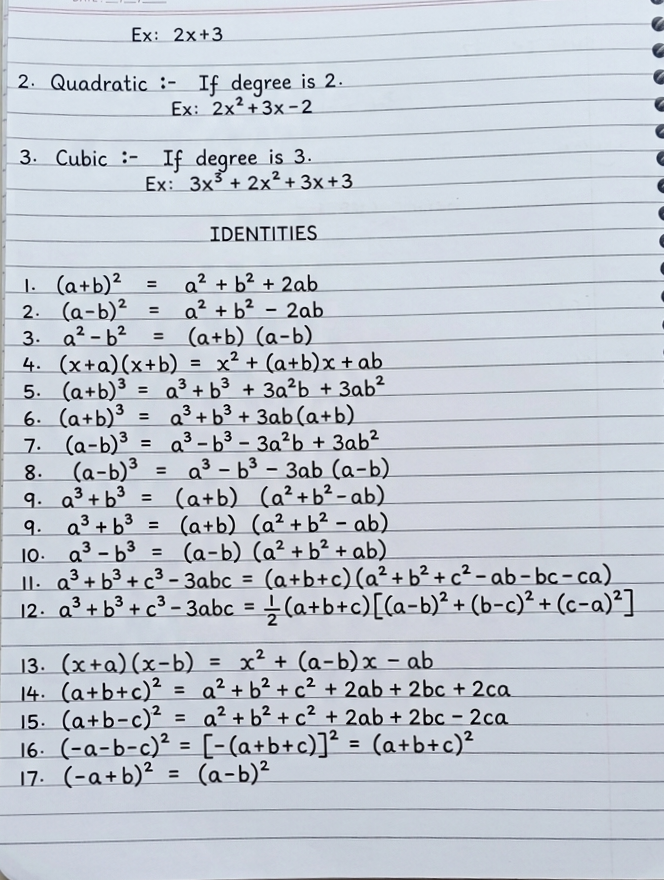
Quadratic Polynomial → Degree 2 (x² + 3x + 1)
Cubic Polynomial → Degree 3 (x³ + x² + x + 1)
🔹 Degree of Polynomial
The highest power of the variable is called the degree.
👉 Example:
3x³ + 2x² + x → Degree = 3
🔹 Value of Polynomial
To find the value, substitute the value of the variable.
👉 Example:
p(x) = x² + 2x
p(2) = 4 + 4 = 8
🔹 Zeros of Polynomial
A value of x that makes the polynomial equal to 0 is called a zero.
👉 Example:
p(x) = x + 2 → Zero = −2
🔹 Remainder Theorem
If a polynomial p(x) is divided by (x − a), then the remainder is p(a).
🔹 Factor Theorem
If p(a) = 0, then (x − a) is a factor of the polynomial.
🔹 Factorisation
Factorisation means breaking a polynomial into simpler factors.
👉 Example:
x² + 5x + 6 = (x + 2)(x + 3)
🔹 Algebraic Identities (VERY IMPORTANT 🔥)
✅ Basic Identities
(a + b)² = a² + 2ab + b²
(a − b)² = a² − 2ab + b²
(a + b)(a − b) = a² − b²
✅ Important Identities
(x + a)(x + b) = x² + (a + b)x + ab
(x − a)(x − b) = x² − (a + b)x + ab
(x + a)(x − b) = x² + (a − b)x − ab
✅ Cubic Identities
(a + b)³ = a³ + b³ + 3ab(a + b)
(a − b)³ = a³ − b³ − 3ab(a − b)
a³ + b³ = (a + b)(a² − ab + b²)
a³ − b³ = (a − b)(a² + ab + b²)
✅ Special Identity
(x + y + z)² = x² + y² + z² + 2(xy + yz + zx)
🔹 Important Points
Number of zeros ≤ degree
Graph cuts x-axis at zeros
Identities help in fast factorisation