
Maths by Vikash Sharma
Expert Educator | Class 9
📘 Class 9 Maths Chapter 1: Number Systems Notes (Complete & SEO Optimized)
🔹 Introduction to Number Systems
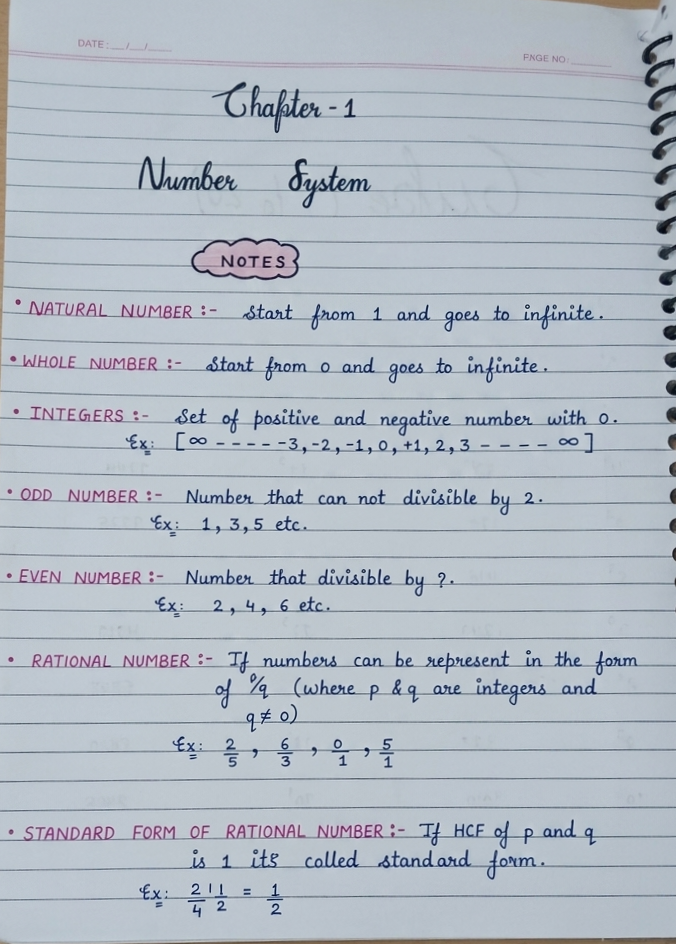
Number system is a way to represent numbers. In this chapter, we study different types of numbers like natural numbers, whole numbers, integers, rational numbers, and irrational numbers.
🔹 Natural Numbers
Natural numbers start from 1 and go to infinity.
Example:
1, 2, 3, 4, 5, …
🔹 Whole Numbers
Whole numbers start from 0 and go to infinity.
Example:
0, 1, 2, 3, 4, …
🔹 Integers
Integers include negative numbers, zero, and positive numbers.
Representation:
… -3, -2, -1, 0, 1, 2, 3 …
🔹 Even and Odd Numbers
✔ Even Numbers
Numbers divisible by 2.
Example: 2, 4, 6, 8 …
✔ Odd Numbers
Numbers not divisible by 2.
Example: 1, 3, 5, 7 …
🔹 Rational Numbers
A number is called a rational number if it can be written in the form:qp
Where p and q are integers and q ≠ 0.
Examples:
2/5, 6/3, 0/1, 5/1
🔹 Standard Form of Rational Numbers
A rational number is in standard form if HCF of p and q = 1.
Example:
2/4 = 1/2
🔹 Rational Number Between Two Numbers
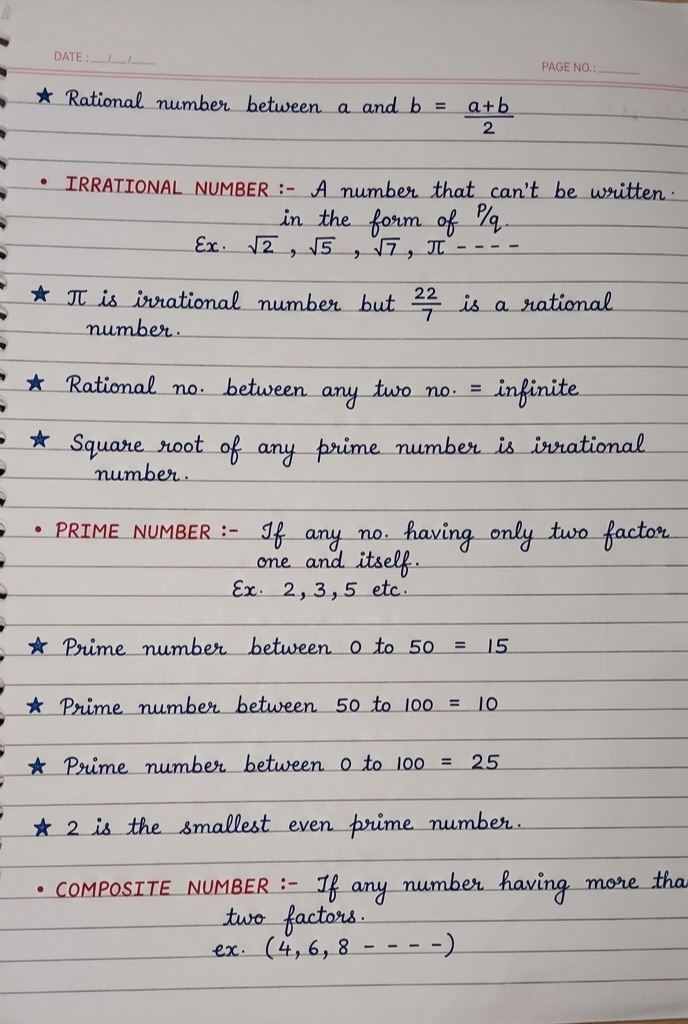
A rational number between a and b is:2a+b
👉 There are infinite rational numbers between any two numbers.
🔹 Decimal Representation of Rational Numbers
Rational numbers can be written in decimal form:
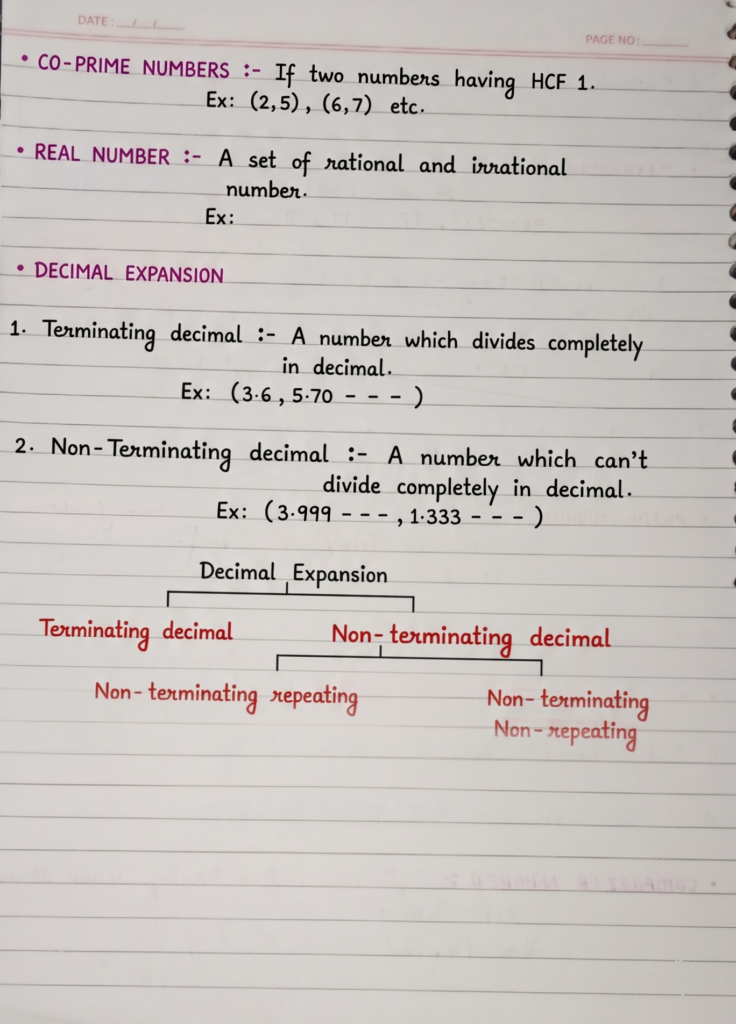
✔ Terminating Decimal
Decimal that ends.
Example:
1/2 = 0.5
✔ Non-Terminating Recurring Decimal
Decimal that repeats.
Example:
1/3 = 0.333…
🔹 Irrational Numbers
Numbers that cannot be written in p/q form are called irrational numbers.
Examples:
√2, √3, √5, π
👉 π is irrational but 22/7 is rational.
🔹 Real Numbers
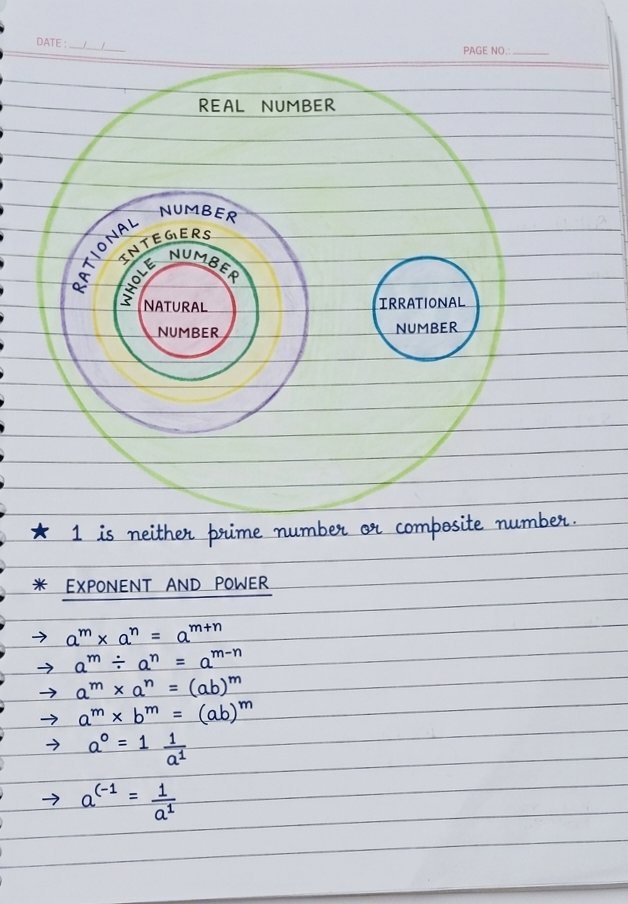
All rational and irrational numbers together form real numbers.
👉 Real numbers include:
- Natural numbers
- Whole numbers
- Integers
- Rational numbers
- Irrational numbers
🔹 Representation of Real Numbers on Number Line
- Every real number can be represented on a number line
- Irrational numbers are located using geometrical methods
🔹 Laws of Exponents
For any non-zero numbers:
- aᵐ × aⁿ = aᵐ⁺ⁿ
- aᵐ ÷ aⁿ = aᵐ⁻ⁿ
- (aᵐ)ⁿ = aᵐⁿ
- a⁰ = 1
- a⁻ⁿ = 1 / aⁿ
🔹 Prime Numbers
A number having only two factors (1 and itself).
Examples:
2, 3, 5, 7 …
Important Facts:
- Prime numbers (0–50) = 15
- Prime numbers (50–100) = 10
- Prime numbers (0–100) = 25
- 2 is the smallest even prime number
🔹 Composite Numbers
Numbers having more than two factors.
Examples:
4, 6, 8, 9 …
🔹 Important Concepts
- Square root of any prime number is irrational
- Rational numbers between two numbers are infinite