
Maths by Vikash Sharma
Expert Educator | Class 10

📘 Triangles Class 10 Notes (Chapter 6)
🔷 Introduction
Triangles are one of the most important topics in geometry. In simple words, a triangle is a closed figure made by joining three line segments.
Since a triangle has three sides, three angles, and three vertices, it forms the foundation of many geometry concepts.
🔹 What is a Triangle?
A triangle is a polygon with three sides.
For example:
△ABC
Here:
- AB, BC, and AC are sides
- ∠A, ∠B, and ∠C are angles
- A, B, and C are vertices
Therefore, every triangle has exactly three angles.
🔷 Similar Figures
Two figures are called similar if they have:
- Same shape
- Equal corresponding angles
- Corresponding sides in the same ratio
Thus, similar figures may have different sizes but the same shape.
🔷 Similar Triangles
Two triangles are similar if:
- Their corresponding angles are equal
- Their corresponding sides are proportional
If triangle ABC is similar to triangle DEF, then:△ABC∼△DEF
Therefore:DEAB=EFBC=DFAC
🔷 Criteria for Similarity of Triangles
There are three main criteria.
🔹 1. AAA Similarity Criterion
If all three corresponding angles are equal, then the triangles are similar.
For example:∠A=∠D ∠B=∠E ∠C=∠F
Hence, both triangles are similar.
🔹 2. SAS Similarity Criterion
If two sides are proportional and the included angle is equal, then the triangles are similar.
That means:DEAB=DFAC
and∠A=∠D
Therefore:△ABC∼△DEF
🔹 3. SSS Similarity Criterion
If all corresponding sides are proportional, then the triangles are similar.
That means:DEAB=EFBC=DFAC
As a result, both triangles become similar.
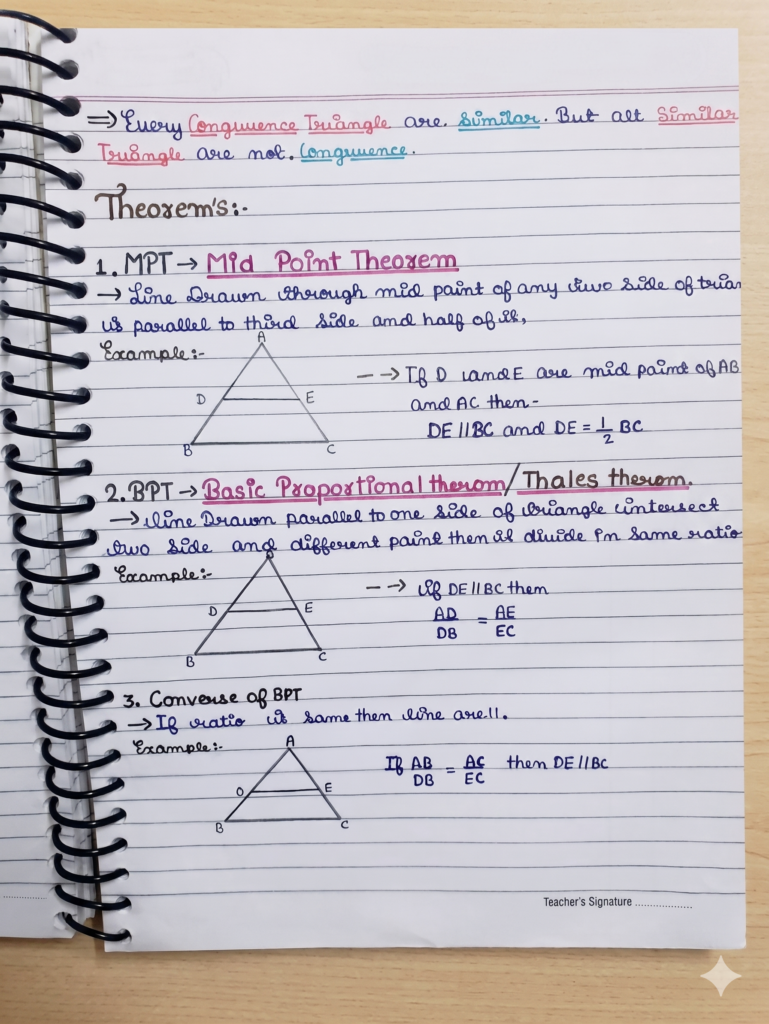
🔷 Basic Proportionality Theorem (BPT)
This theorem is also called the Thales Theorem.
Statement:
If a line is drawn parallel to one side of a triangle, then it divides the other two sides in the same ratio.
In △ABC, if DE || BC, then:DBAD=ECAE
Therefore, parallel lines create proportional segments.
🔷 Converse of BPT
If a line divides two sides of a triangle in the same ratio, then that line is parallel to the third side.
Thus, proportional sides prove parallelism.
🔷 Areas of Similar Triangles
If two triangles are similar, then:Area of △2Area of △1=(Corresponding Side2Corresponding Side1)2
Hence, area ratio equals the square of side ratio.
🔷 Pythagoras Theorem
In a right-angled triangle:(Hypotenuse)2=(Base)2+(Perpendicular)2
That means:c2=a2+b2
For example, if a = 3 and b = 4:c2=9+16=25 c=5
🔷 Converse of Pythagoras Theorem
If:c2=a2+b2
then the triangle is right-angled.
Therefore, side lengths can help identify the type of triangle.