
Maths by Vikash Sharma
Expert Educator | Class 10
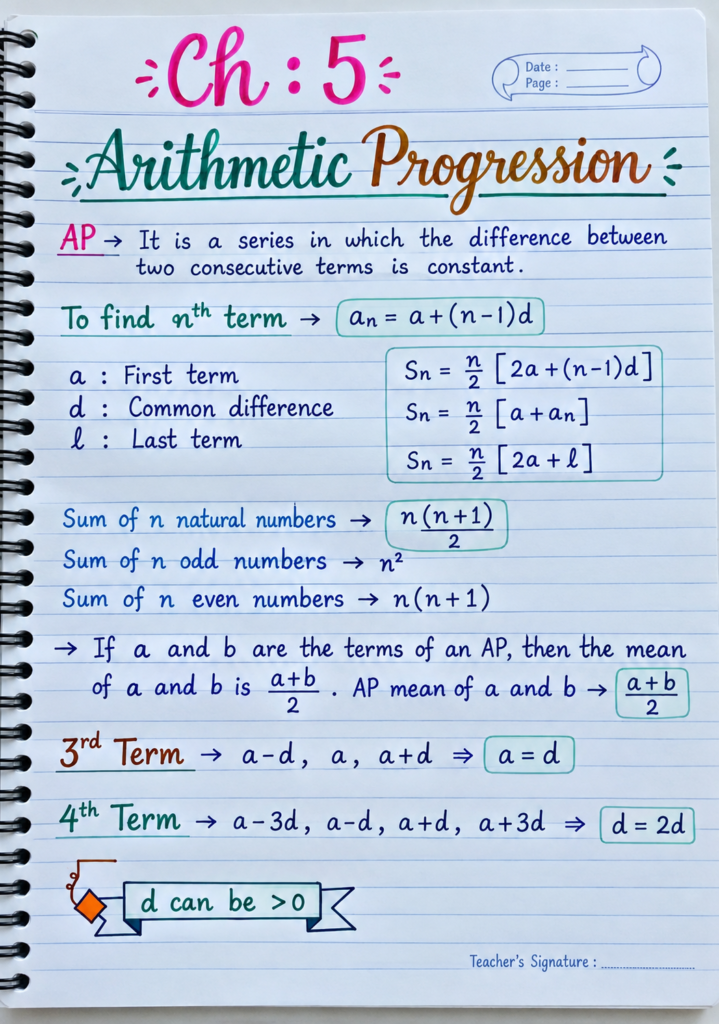
📘 Arithmetic Progressions Class 10 Notes (Chapter 5)
🔷 Introduction
Arithmetic Progression, also called AP, is an important topic in mathematics. In simple words, an arithmetic progression is a sequence of numbers where the difference between consecutive terms remains the same.
For example:
2, 5, 8, 11, 14…
Here, the common difference is 3.
Therefore, this sequence is an arithmetic progression.
🔹 What is Arithmetic Progression?
A sequence is called an arithmetic progression if:a2−a1=a3−a2=a4−a3
This fixed difference is called the Common Difference (d).
🔹 Important Terms in AP
✔ First Term (a)
The first number of the sequence is called the first term.
Example:
In 3, 7, 11, 15…
First term = 3
✔ Common Difference (d)
The difference between two consecutive terms is called the common difference.
Formula:d=an−an−1
Example:
7−3 = 4
So, d = 4
✔ Number of Terms (n)
The total number of terms is represented by n.
🔷 General Form of AP
The general form of arithmetic progression is:a, a+d, a+2d, a+3d,…
Thus, every term can be found easily.
🔷 nth Term of AP
The nth term of an arithmetic progression is:an=a+(n−1)d
Where:
- a = first term
- d = common difference
- n = number of terms
🔹 Example of nth Term
Find the 10th term of:
2, 5, 8, 11…
Here:
a = 2
d = 3
n = 10
Using formula:an=a+(n−1)d a10=2+(10−1)×3 a10=2+27 a10=29
Hence, the 10th term is 29.
🔷 Sum of n Terms of AP
The sum of first n terms is:Sn=2n[2a+(n−1)d]
Another important formula is:Sn=2n(a+l)
Where l is the last term.
🔹 Example of Sum Formula
Find the sum of first 5 terms:
2, 5, 8, 11, 14…
Here:
a = 2
d = 3
n = 5
Using formula:Sn=2n[2a+(n−1)d] S5=25[4+12] S5=25×16 S5=40
Therefore, the sum is 40.
🔷 Important Properties of AP
✔ If d > 0
The sequence increases.
✔ If d < 0
The sequence decreases.
✔ If d = 0
All terms become equal.
As a result, the commo📘 Arithmetic Progressions Class 10 Notes (Chapter 5)