
Maths by Vikash Sharma
Expert Educator | Class 10
NOTES
📘 Some Applications of Trigonometry Class 10 Notes (Chapter 9)
🔷 Introduction
Trigonometry helps us solve many real-life problems. In simple words, it helps us find height and distance without measuring them directly. For example, we can find the height of a tower, a tree, or a building. Therefore, this chapter connects maths with everyday life.
Moreover, these concepts help students understand how engineers and surveyors work.
🔷 Line of Sight
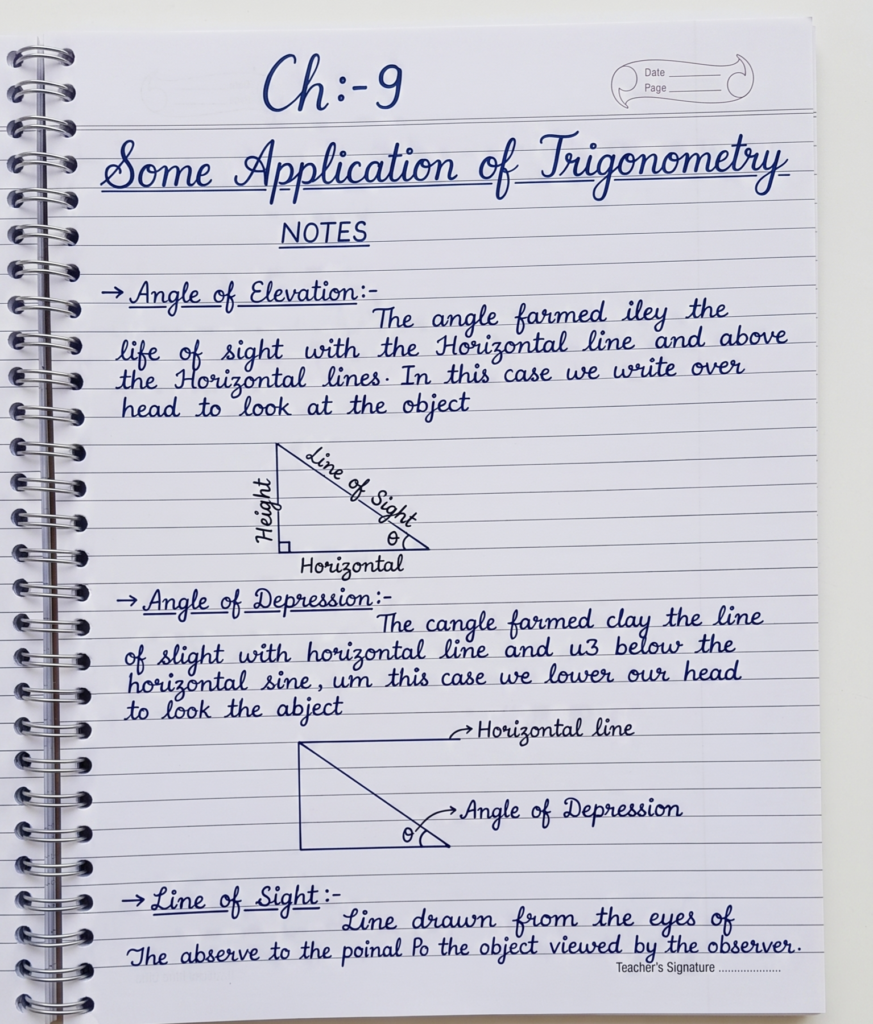
When you look at an object, your eye creates a straight line toward that object. We call this line the line of sight.
For instance, when you look at the top of a tower, your eyes form a line between you and the tower. Thus, every height and distance problem starts with the line of sight.
🔷 Horizontal Line
A horizontal line runs parallel to the ground. Your eye level creates this line naturally.
In addition, this line helps us measure angles correctly. Therefore, it plays an important role in trigonometry diagrams.
🔷 Angle of Elevation
When you look upward at an object, your line of sight forms an angle with the horizontal line. We call this angle the angle of elevation.
For example, you create an angle of elevation when you look at:
- A tall building
- A mountain
- A flying kite
- The top of a tower
Hence, the object always stays above your eye level.
🔷 Angle of Depression
Sometimes you look downward at an object. In that case, your line of sight forms an angle below the horizontal line. We call this angle the angle of depression.
For example, you create this angle when you look:
- From a bridge to a road
- From a hill to a car
- From a building to the ground
As a result, the object stays below your eye level.
🔷 Important Trigonometric Ratios
We use trigonometric ratios to solve height and distance questions. Most importantly, tangent helps in most problems.
Tangent Ratio
tanθ=BasePerpendicular
Therefore, we often choose tangent first.
Sine Ratio
sinθ=HypotenusePerpendicular
Similarly, sine helps when hypotenuse is known.
Cosine Ratio
cosθ=HypotenuseBase
Likewise, cosine helps when the base is important.
🔷 Height and Distance Formula
In most questions:tanθ=DistanceHeight
Therefore, we get:
Height Formula
Height=Distance×tanθ
Distance Formula
Distance=tanθHeight
Thus, these formulas solve most chapter problems.
🔷 Solved Example
Example
A tree is 20 m high. The angle of elevation from a point on the ground is 45°. Find the distance between the tree and the point.
Solution
Given:
Height = 20 m
Angle:θ=45∘
Now we use:tan45∘=DistanceHeight
We know:tan45∘=1
So:1=Distance20
Therefore:Distance=20m
Answer:
Distance = 20 m
🔷 Important Points
- Angle of elevation always points upward.
- Angle of depression always points downward.
- Horizontal lines stay parallel.
- Equal alternate angles help in diagrams.
Most importantly, always draw a neat figure before solving.
🔷 Real-Life Uses
People use trigonometry in many fields. For example, it helps in:
- Construction
- Aviation
- Navigation
- Surveying
- Architecture
- Mountain measurement
Therefore, this chapter has many practical uses.
The straight line between the observer and the object.
The angle formed when the object is above eye level.
The angle formed when the object is below eye level.
Tangent ratio is used most often.
Height=Distance×tanθ