
Maths by Vikash Sharma
Expert Educator | Class 10
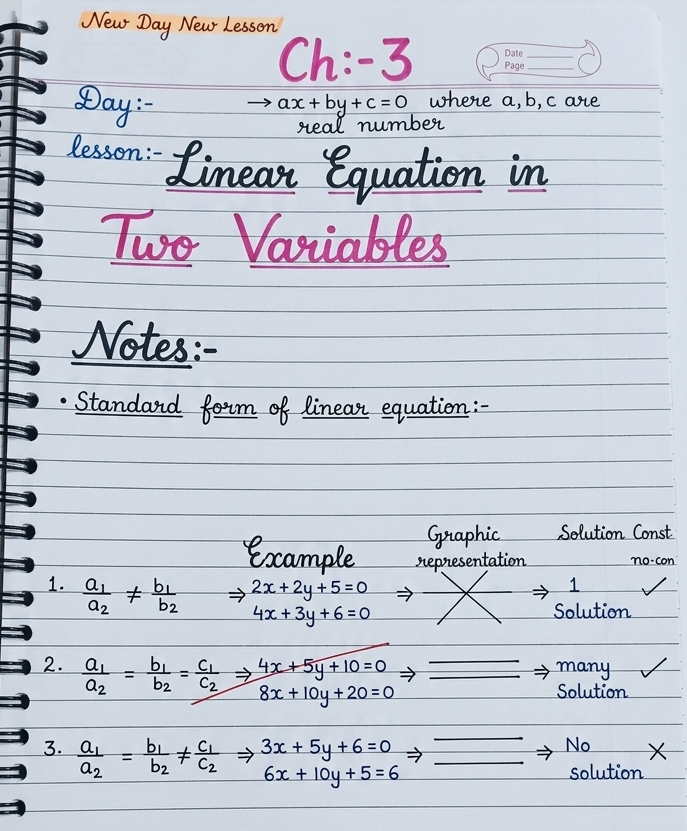
📘 Linear Equations in Two Variables Class 10 Notes (Chapter 3)
🔷 Introduction
Linear equations in two variables are an important part of algebra. In simple terms, these equations contain two variables, usually x and y.
For example:ax+by+c=0
Here, a, b, and c are real numbers, and both a and b are not zero.
🔹 Standard Form of Linear Equation
The standard form of a linear equation in two variables is:ax+by+c=0
Therefore, every linear equation can be written in this form.
🔹 What Does It Represent?
A linear equation in two variables represents a straight line on a graph.
Hence, solving such equations means finding the point where lines intersect.
🔷 Conditions for Solutions
When we have two linear equations:a1x+b1y+c1=0 a2x+b2y+c2=0
We compare ratios:
🔹 Case 1: Unique Solution (One Solution)
a2a1=b2b1
In this case, the lines intersect at one point.
Therefore, the system has a unique solution.
👉 Example:
2x + 2y + 5 = 0
4x + 3y + 6 = 0
🔹 Case 2: Infinite Solutions
a2a1=b2b1=c2c1
Here, both equations represent the same line.
As a result, there are infinitely many solutions.
👉 Example:
4x + 5y + 10 = 0
8x + 10y + 20 = 0
🔹 Case 3: No Solution
a2a1=b2b1=c2c1
In this situation, the lines are parallel.
Therefore, they never meet and have no solution.
👉 Example:
3x + 5y + 6 = 0
6x + 10y + 5 = 0
🔷 Graphical Representation
- Intersecting lines → One solution
- Coincident lines → Infinite solutions
- Parallel lines → No solution
Thus, graphs help us understand solutions visually.